Letter of News: THE RIVER HAS ROOTS wins Locus and Nebula Awards
Dear Friends,
I last wrote on March 24, from the Pacific, the day Seasons of Glass and Iron was released into the world, on the cusp of travelling to promote it. Today is June 5, and I'm stunned to look up and see the year's halfway point in the near distance. A week ago I started writing what I intended to be an ambitious newsletter, gathering up all the travel I've done since then – the US tour, the UK tour, the beautiful events in Montreal and Ottawa, the jaunt to Halifax for TriCon, a lovely quick visit to Toronto to catch Brennan Lee Mulligan's Endless Dungeon, and then a week in France, between Paris and Épinal, for a wonderful festival called Les Imaginales.
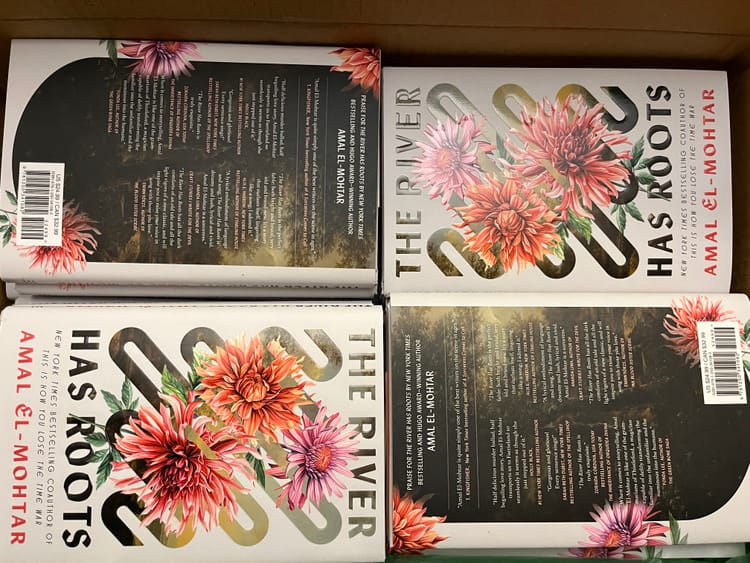
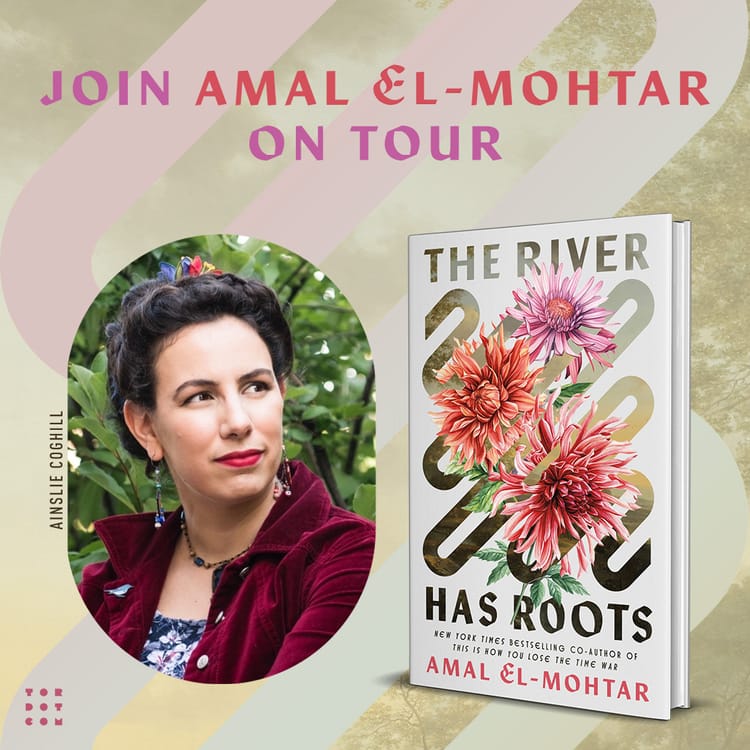
And then somehow The River Has Roots won a Locus and a Nebula for Best Novella and I felt like I should write about that instead?

(For anyone wondering what these awards are: the Locus Award is given out by Locus Magazine, a unique and important piece of SFF community infrastructure that I've long encouraged people to support with subscriptions if they can. Anyone can nominate works for the Locus and vote for them, but magazine subscriber votes are weighted more heavily. The Nebula Award is presented by the Science Fiction and Fantasy Writers' Association (SFWA), and SFWA members nominate and vote on them.)
I was in France when I learned about the Locus – I woke up a little early to go birding and saw a text from my husband congratulating me. This made me a little teary, because he was also the one to deliver the news of my first Locus award – the first award I'd ever received for fiction, for "The Truth About Owls" in 2015. At the time he was still my fiancé, and an ocean away from me in Scotland. Our positions were reversed, this time, with me in France and him in Canada, but the distance bridged was roughly the same, and having someone care enough about me to track what award is being presented when while I do my best not to think about it is a profound and lovely gift.
I pre-recorded a speech in case of acceptance, and you can listen to it here if you like; it should hopefully click through to the right spot in the ceremony but the time stamp is 1:29 or so.
Because of travel, and anxiety, and how brutally difficult a time I have recording video of myself – not to mention the feeling that, for various reasons, I didn't want to just repeat the same words – I recorded the Nebula acceptance speech in even more of a hurry than the Locus, and in so doing, created a nightmare scenario so diabolical I lacked the ability to conceive of it even to frighten myself. Which is to say: I messed up thanking some excellent people and didn't notice until the speech was broadcast. A truly mortifying thing to realize when you're trying to manage feelings about having received a significant honour knowing you're also about to use the platform to talk about heavy business!
So, I'm just going to post the speech here in text, in lieu of the erroneous video, with apologies to Spencer Fuller and Steve Wagner for messing up the things I was thanking them for.
This is such an honour, made all the greater by the abundance of riches on the novella ballot. Thank you to everyone who placed The River Has Roots in this incredible company, and to all the SFWA volunteers who work so hard to make this event possible every year.
I want to thank DongWon Song, my agent and dear friend; my editorial teams in the US and UK, especially Ali Fisher, Dianna Vega, and Anne Perry; and my husband Stu, for relentless and necessary encouragement throughout the writing and revision process. Thanks to Kathleen Neeley for the gorgeous illustrations and Spencer Fuller for the beautiful cover; to Steve Wagner at MacMillan Audio for enchanting soundscaping, for encouraging my sister and me to play music and sing on the audiobook, and for finding Gem Carmella – a jewel worthy of her name – to narrate it. Deepest thanks go to my sister, Dounya, for being the kind of person who inspires me to write about how much I love her because it’s more efficient than constantly shouting it from rooftops.
The River Has Roots is about love, and grief, and sisters, but it’s also about language. As writers, we speak a great deal about the power of words to give vent to feelings and articulate difficult truths – but we speak less of the power of words to diffuse responsibility and paper over atrocity. I wrote and revised this book under the mental duress of seeing Israel’s genocidal violence against my people denied, excused, laundered, in the same language I use to tell stories; I’m receiving this award in the context of those crimes daily worsening with impunity.
If you know this, and haven’t spoken against it, I want to ask: what stops you?
I understand that it can feel enormous and overwhelming to be confronted with so much horror. It can feel impossible to know where to begin. I want to exhort you all: begin by speaking the truth. Begin by naming the perpetrators and their victims, by recognizing that there is no equivalence between them. As individuals, and as members of an organization dedicated to "informing, supporting, promoting, defending, and advocating for writers," I want to ask you: What stops you from wielding the enormous power of your words on behalf of the powerless, and against those actively and maliciously destroying them?
This is a book about how magic is a kind of grammar and grammar is a kind of magic. It may be a writer's fantasy to believe that if you speak truly enough, loudly enough, often enough, you can change the world – but we’re all writers here, and it being a fantasy is no reason not to try. So: Free Palestine. Trans rights are inviolable human rights. So is migration. We are bound together in this world to work for the liberation of all people.
I am honoured by the receipt of this award. Thank you.
I think I may be losing some nimbleness of thought to the fragmentation of sharing platforms. Back in the days of Livejournal, I'd just write reams and reams of text and then program in little cuts to organize them, so that any given post could have subheadings in a tidy list that you could click to expand what you most wanted to read, like a wiki. Something about that made it easier to write in the aftermath of travel, or a convention – I could cut the entry day by day, be as sprawling and comprehensive as I liked within each section, and in the end there would still be a shape of post that looked, to my mind, inviting rather than intimidating.
In a newsletter, I feel some impetus towards coherence, brevity, shape – so instead I have dozens of partially written letters that all feel surpassed by other events before I can finish them. It's a perennial problem I'm not sure how to address, but I'm trying; there are so many flowers I want to press into the book of this year before they fade from my memory. Increasingly I feel like if I don't, if I don't make some record of them, that I'll lose them in some deep substantive way – lose them as a place to revisit, dwell in, smile at, draw nourishment from while moving forward to whatever's next.
In the meantime, though, I have these flowers from my sister.

Wishing you all the best as we approach the solstice,
Love,
Amal
Postscripts of News:
- I reviewed Fonda Lee's new book, The Last Contract of Isako, for the NYTBR.
- I desperately want everyone to read this excellent article by Ted Chiang titled "No, Artificial Intelligence is Not Conscious." Chiang's writing is always lucid, thoughtful, and thought-provoking, but reading this felt like drinking cool clean water on a very hot day during which people keep trying to convince me to slake my thirst with piss.
- I'm planning to be at the Deep Water Festival in Narrowsburg, NY from June 19-21, and hope to see folks there!
Member discussion